
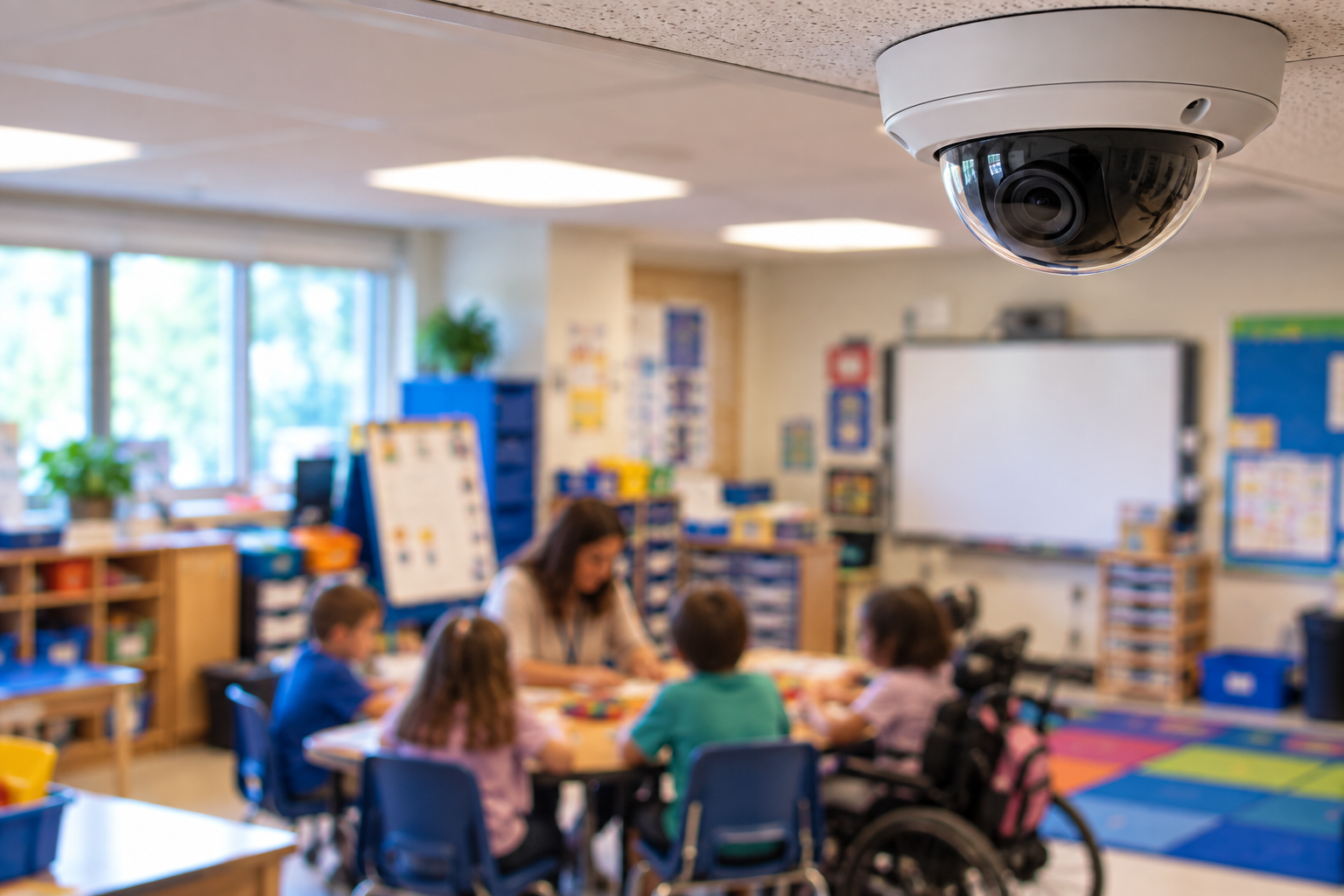
Every morning, parents across Florida send their children with disabilities to school and trust that the adults caring for them will keep them safe. For most children, that trust is well placed. There are dedicated teachers, paraprofessionals and school staff doing extraordinary work every day.
But many of us have seen news stories of children with disabilities being hurt, mistreated, neglected and abused in schools. Some of the incidents that have received the greatest public attention were exposed only because someone happened to have a cell phone recording or because video existed that showed what actually occurred.
That raises a difficult question: Why should protecting a vulnerable child depend on whether someone happens to pull out a phone?
This is why Florida needs cameras in special education classrooms.
When a Child Can’t Tell You What Happened
The number one reason for cameras is simple: some children cannot come home and tell their families what happened to them at school.
That doesn’t mean they necessarily don’t speak. Communication is far more complicated than whether someone can speak or not.
A child may use spoken language but be unable to describe a complicated event. A student may have difficulty sequencing what happened, identifying who was involved, understanding that something inappropriate occurred or answering a parent’s questions. Some students communicate through AAC or other methods. Others may communicate very little about their school day at all.
A child may come home with a bruise, begin displaying new behaviors, suddenly become afraid of school, stop sleeping, become aggressive or show other signs that something is wrong. A parent knows their child well enough to recognize that something has changed, but the child may not be able to explain why.
Imagine knowing that something happened to your child but having no way to find out what it was.
For some families of children with disabilities, that is not a hypothetical situation.
We’ve Seen What Can Happen
Over the years, videos recorded inside schools have shown incidents involving students with disabilities that are incredibly difficult to watch. Those videos force us to confront something uncomfortable. If nobody had recorded the incident, would anyone have known?
That’s the part of this conversation we cannot ignore.
A child who cannot reliably report what happened is uniquely vulnerable. If the only people who can describe an incident are the adults who were involved in it, parents are being asked to rely entirely on the system to investigate itself.
Child-safety policies aren’t created because we assume everyone will do something wrong. They exist because children deserve safeguards when someone does.
Cameras provide one of those safeguards.
Cameras Are Not Livestreams for Parents
Supporting classroom cameras doesn’t mean giving parents a livestream into their child’s classroom. It doesn’t mean administrators sit at their desks watching teachers, and it doesn’t mean recordings are used to evaluate educators.
The purpose is be far more limited.
When there is a serious concern involving the safety or well-being of a student, a recording should exist so that the incident can be reviewed.
Despite the significant degree of MISINFORMATION that’s being distributed by schools to parents regarding cameras in classrooms, cameras could be there for documentation when something goes wrong.
We already use cameras throughout schools. They can be found at entrances, in hallways, in common areas and on school buses. Yet a child may spend six hours of the school day inside a classroom where no such record exists.
For children who may not be able to tell someone what is happening behind that door, that gap in protection matters.
Florida Has Already Taken a First Step
Florida isn’t new to this conversation. State law created a video-camera pilot program in Broward County involving self-contained special education classrooms. That program demonstrated something important: cameras can be used while still establishing rules around privacy, access to recordings and how footage may be used.
During the 2026 legislative session, lawmakers again considered legislation addressing cameras in self-contained classrooms. House Bill 859 and Senate Bill 1170 did not become law, due to leadership of the Senate Education Committee failing to place it on the agenda for review.
But children didn’t become less vulnerable because a bill failed to pass.
As Florida prepares for another legislative session, we will once again be advocating for legislation addressing cameras in special education classrooms.
Cameras Won’t Prevent Every Incident
A camera alone will not make a classroom safe. We still need qualified teachers, properly trained paraprofessionals, adequate staffing, effective behavior supports, strong administrators and meaningful communication with families.
We also need schools to take concerns seriously when parents say something has changed with their child.
But cameras provide something those other safeguards cannot always provide: a record.
If a child comes home injured and nobody can explain what happened, a recording can provide the answers.
If a parent notices a dramatic change in behavior and later learns there was a serious classroom incident, a recording can provide the answers.
If accounts of an incident conflict, a recording can provide the answers.
And if a child is being mistreated by someone entrusted with their care, a camera may provide the evidence needed to stop it from happening again.
Who Is Watching Out for the Child?
That’s ultimately the question that deserves an answer.
Parents of children with disabilities are asked to place an enormous amount of trust in schools. We hand our children over every morning and expect them to return home safe.
For parents whose children cannot reliably tell them what happened during those hours, that trust is even greater.
We should not have to wait for another shocking cell phone video to appear on the evening news before asking whether we could have done more to protect a child.
We should do more before it happens.
Cameras are not the entire answer to school safety. But they can be one important layer of protection, accountability and transparency.
As parents of children with disabilities again pursue legislation for cameras in classrooms, one question should be held at the center of the discussion:
If a child cannot tell us what is happening behind the classroom door, what are we willing to do to make sure that child is safe?
…. a recording can provide the answers.